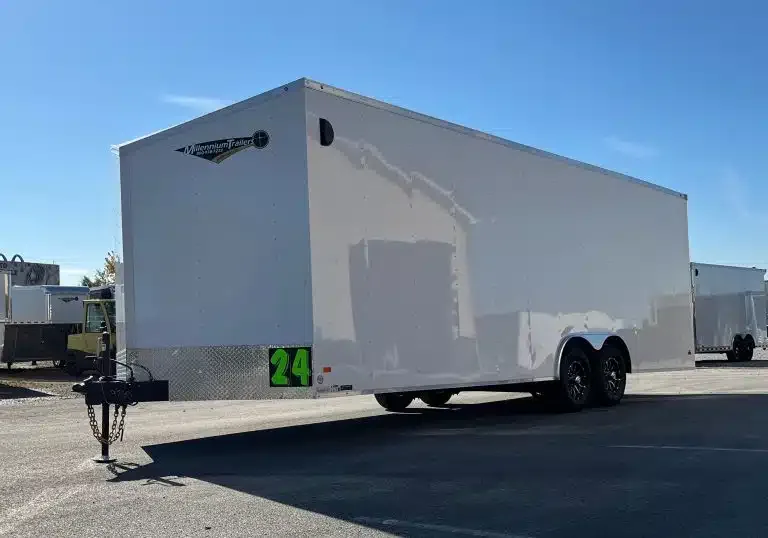
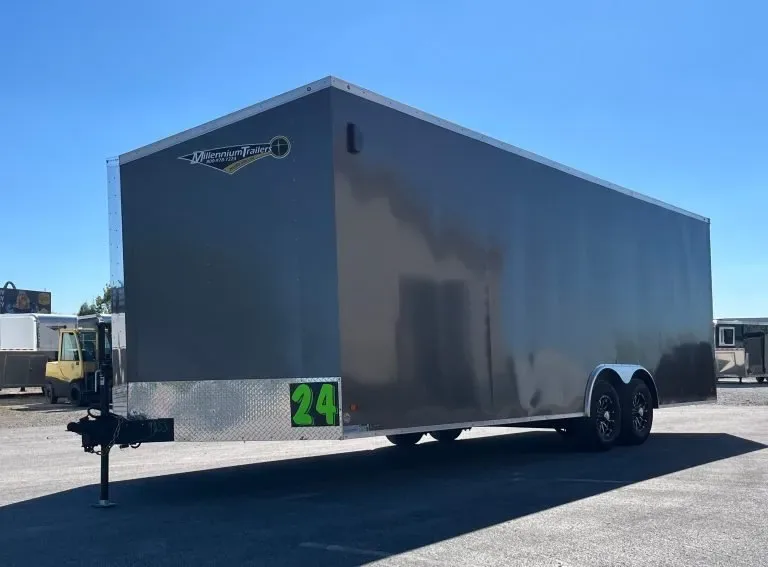
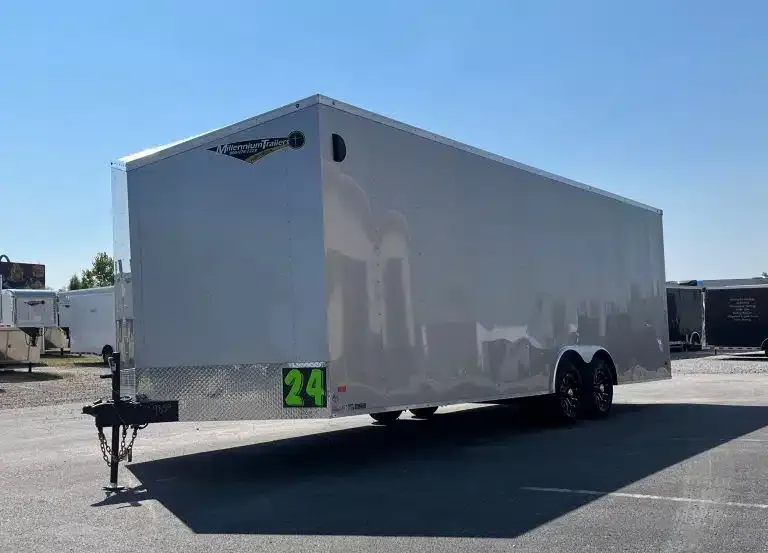
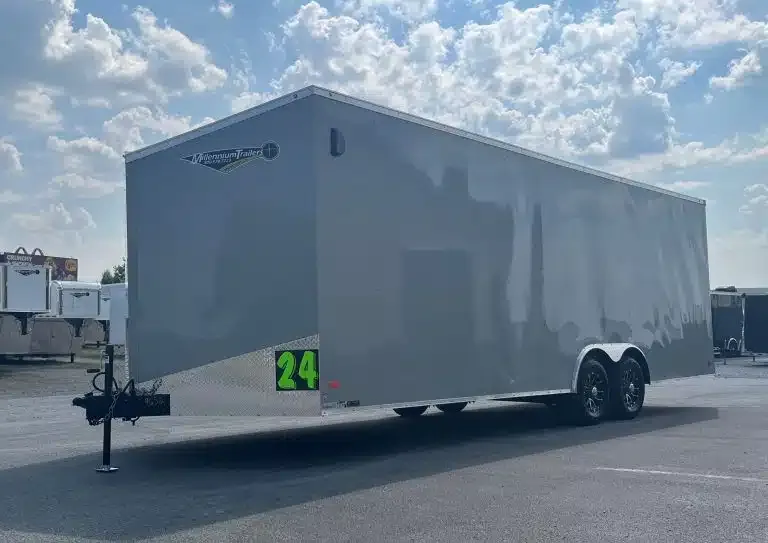
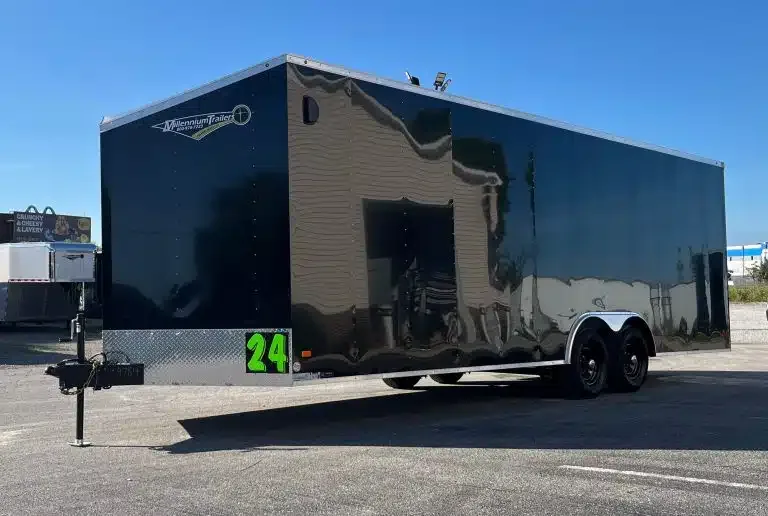
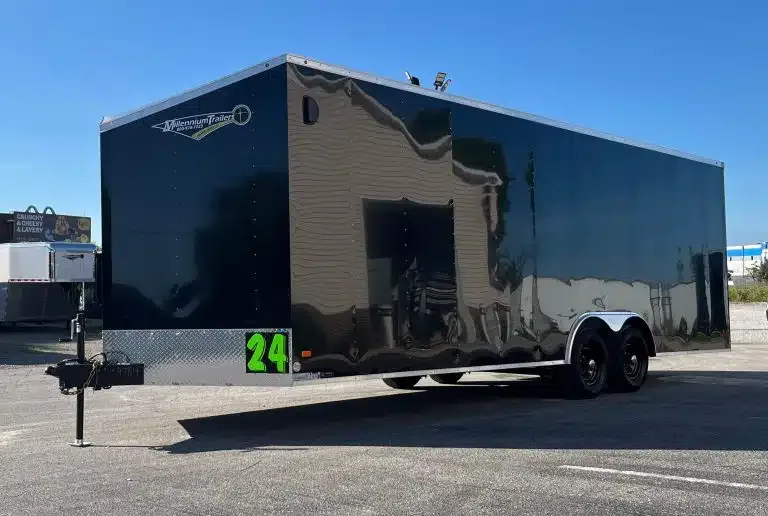
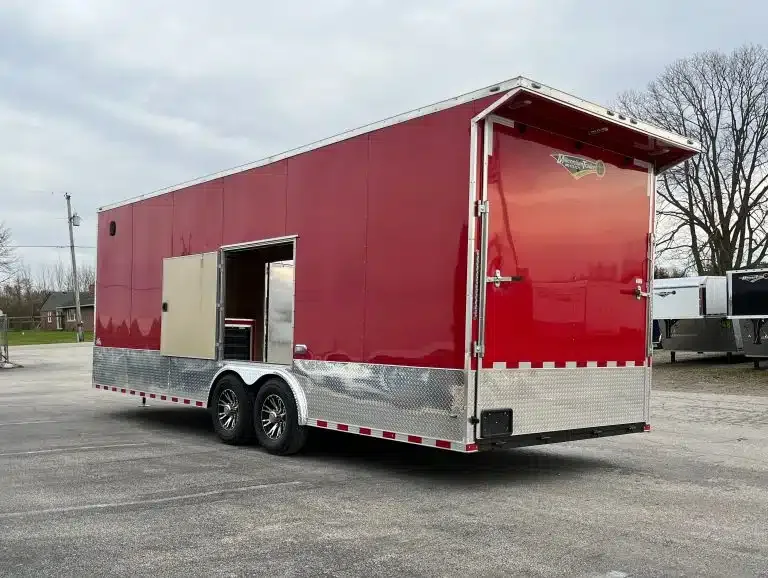
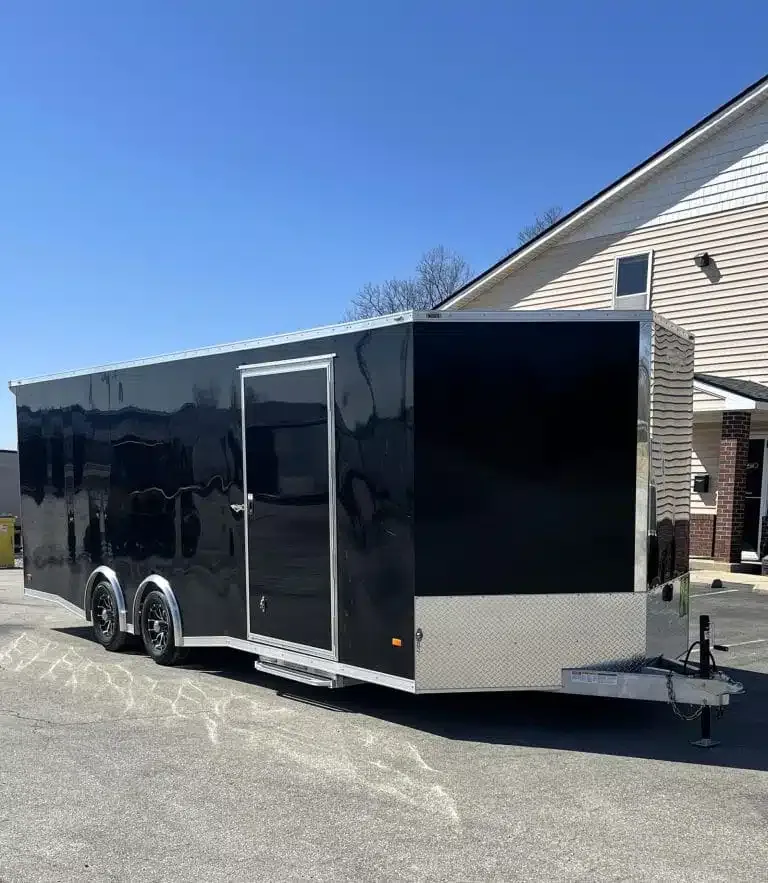
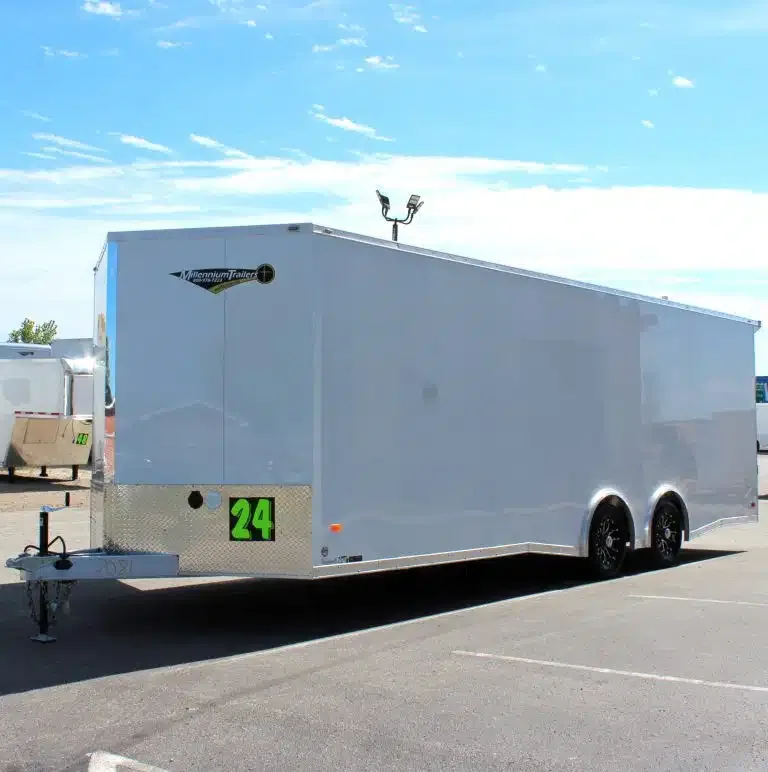
 Enclosed Car Hauler 2026 24ft. Aluminum Blaze w/Finished Interior & Aluminum Wheels 0862 — tap to view
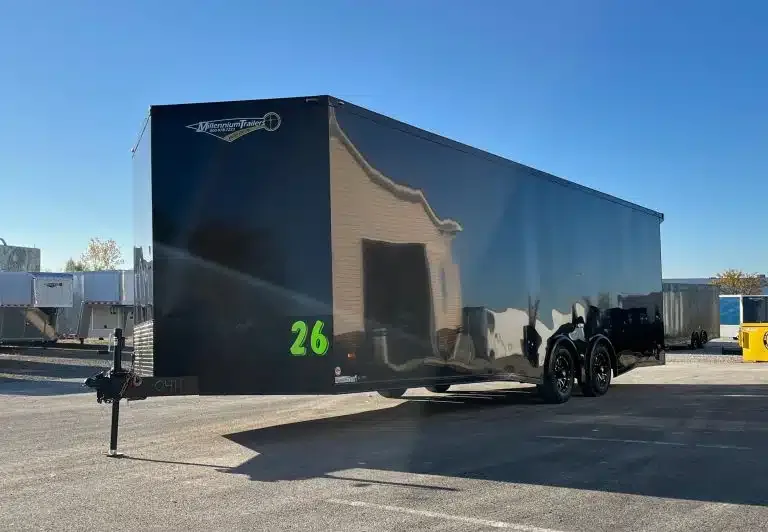 Enclosed Car Hauler 2025 26ft. Blaze w/Finished Interior & Black-Out Package 0411 — tap to view
Start with the car, not the trailer
Measure the longest vehicle you will load, bumper to bumper, and add two feet. That two feet is straps, the frame of the ramp door, and enough room to open a car door once it is inside. A 16 ft car in a 20 ft box is a fit. A 16 ft car in a 20 ft box alongside a floor jack, a tire rack, a generator and a tool chest is not.
The number in the listing is the box, not the usable floor. A wedge V-nose front changes where the nose of the car sits, a beavertail drops the last foot, and the ramp opening frames the rest. If you are within six inches either way, ask for the one measurement that settles it: floor length from the ramp hinge to the front wall.
What each length actually buys
- 20 ft — one car, tightly. The 20 ft Haulmark Edge in stock gets a low car up with a 48 in. beavertail and a medium-duty ramp door with flap, and the 30 in. slant wedge V-nose leaves a small area up front for tires and tools. No walk-around room.
- 24 ft — one car plus a few feet of gear, or a full-size truck. This is where most buyers land. The 24 ft Millennium Hero runs two 5,200 lb drop spring axles under about 7 ft of interior height; the Econo-Max at the same length runs 7,000 lb torsion axles under roughly 8 ft and carries 14 recessed D-rings, a mounted toolbox and cabinets.
- 26 to 28 ft — one car with real working space, or a car plus a quad. The 28 ft Millennium Extreme runs two 6,000 lb spread torsion axles, a 72 in. beavertail and a 40 in. x 32 in. generator door and compartment. A 28 ft Haulmark Edge with the Turbo Package is the same idea in a different build.
- 34 ft — two small vehicles, or one car plus a corner bathroom and awning. The 34 ft Millennium units on the lot carry a large corner bathroom and an electric awning, which makes them race-weekend trailers rather than plain haulers.
Two things bite people at the top of that list. A 34 ft trailer needs a place to park and turn it, and it needs a tow vehicle rated for the loaded weight — not the empty weight. Check both before you fall for the floorplan.
Axle rating and GVWR are not the same number
Axles tell you what the running gear can carry. GVWR is what the trailer is plated for. Two 6,000 lb axles give 12,000 lb of axle capacity, but the GVWR on the spec sheet is often lower than that sum, and GVWR is the number that governs what you can legally load.
Payload is GVWR minus the empty weight of the trailer, and empty weight frequently is not on the listing. Ask for it. Then add up what you are actually putting aboard: car, fuel, spares, tools, generator, cabinets, water. A 3,000 lb car and 1,500 lb of gear in a trailer with a 7,000 lb payload leaves margin. The same load in a 5,000 lb payload trailer does not, and you will feel it on a crosswind at 70 mph long before a scale tells you.
Axle type matters too. Torsion axles ride independently and sit lower; drop spring axles are simpler and cheaper to service. Spread axles put distance between the two and steady the trailer under load, at the cost of a wider turning footprint.
Ramp door, rear opening and beavertail
The ramp door is where a low car either loads cleanly or scrapes its nose. Three measurements decide it: the ramp door rating, the width of the rear opening, and how much beavertail there is. The Haulmark Edge at 20 ft has a 96 in. wide rear opening and a 48 in. beavertail; the 28 ft Extreme goes to 72 in. of beavertail.
A beavertail is the floor dropping at the back of the trailer, and every inch of it flattens the angle between ramp and deck. If you haul a car with a splitter, a long nose or a low exhaust, that angle is the whole ballgame. Ask what the ramp door is rated for loaded, and check the hinge and the flap before you tow it home — a tired hinge shows as a sag you can see with the door half down.
Escape doors and side doors
An 8 ft wide trailer with a 6 ft wide car in it does not leave room to open the driver's door. That is what escape doors are for. The Haulmark Edge uses a premium escape door with a removable wheelbox, so the driver climbs out with the car loaded tight to the front. The Econo-Max uses a 54 in. x 48 in. escape door; the ATC ROM units use a large escape door in the side wall.
If you load and unload alone, at night, at a track, this is the option you will use every single time. Side doors are separate: a 36 in. door with a barlock gets you in and out without dropping the ramp, and a 48 in. door with a FlushLock gives you a usable doorway instead of a hatch. Cargo that goes in through the side door — jacks, coolers, chairs — saves you lowering the ramp a dozen times a weekend.
Interior finish: what you are paying for
Bare trailers come with 3/8 in. plywood or engineered walls and a 3/4 in. floor. That is honest and it works: rolling tires, straps and a loaded car do not care. Finished trailers add white vinyl or PolyCor wall panels, an insulated ceiling, black coin rubber flooring over the deck, base and overhead cabinets, and interior lighting.
Pay for the finish if the trailer doubles as a workshop, a paddock office or a place you sleep. Skip it if it is a box that moves a car four times a year. The middle ground is worth knowing about: coin flooring and a couple of cabinets, bare walls, good lights. That is the build most private owners end up happy with.
Flooring is the one upgrade that pays back regardless. Bare plywood gets slick with water and oil and it stains; coin rubber grips a wet shoe and wipes clean. If you are loading in the rain in the Southeast, take the coin floor.
Power, vents and the small things
A 30 amp electrical package with a convertor and a lithium battery lets you run lights and tools without a shore hookup — the ATC ROM 550 has exactly that, plus A/C prep and awning prep. A generator door and compartment, like the one on the 28 ft Extreme, keeps a generator outside the living space and accessible without opening the ramp.
Vents matter more than people expect. Two manual roof vents move hot air out of a sealed box; a trailer that sits in a Carolina July will hit 130°F inside without them. In-floor or ceiling 12V lights mean you can load after dark. A winch plate is cheap at build time and expensive to add later.
Before you commit
Four checks, in order. First, tow rating: your truck's capacity against the loaded trailer weight, not the empty weight. Second, storage: a 28 ft trailer plus a tow vehicle needs length and a turning circle, and most subdivisions will not take it in the driveway. Third, hitch and wiring: a 7-pin connector, a brake controller and the right ball height. Fourth, warranty: the coverage comes from the builder — 3-year structural on the Haulmark and ATC units, 5-year limited on the Econo-Max — and it is the manufacturer's warranty, not ours.
You can inspect any unit at the lot in Concord by appointment, tow it home yourself, or have it delivered. Delivery is quoted to your ZIP and written on the invoice before anything is paid; nothing is charged on the website. See the full lineup on the enclosed trailers page, or read how ordering and payment work on payment methods.