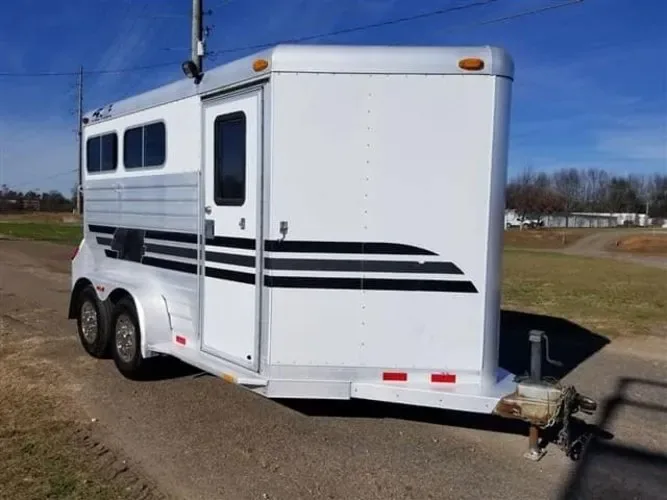
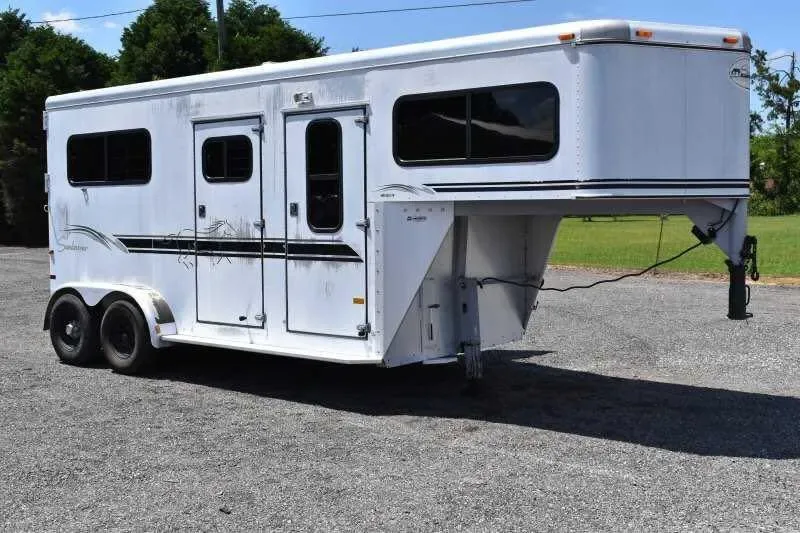
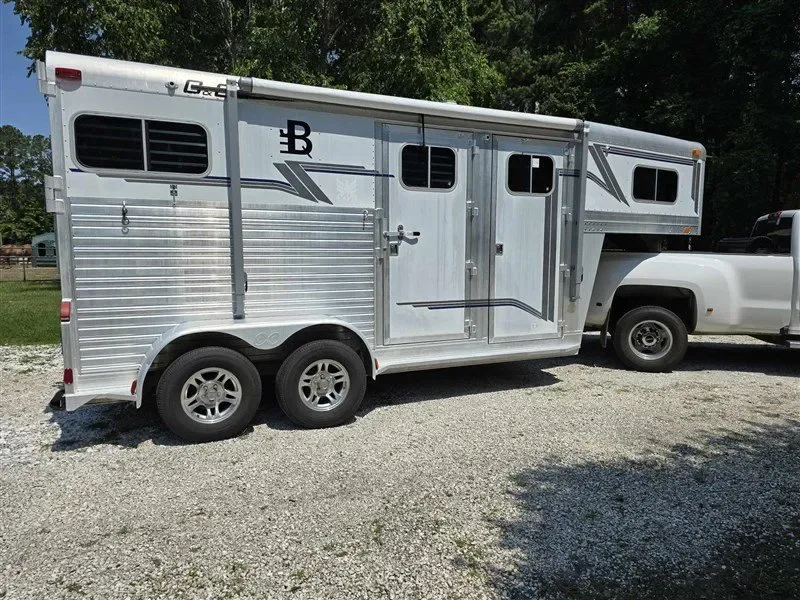
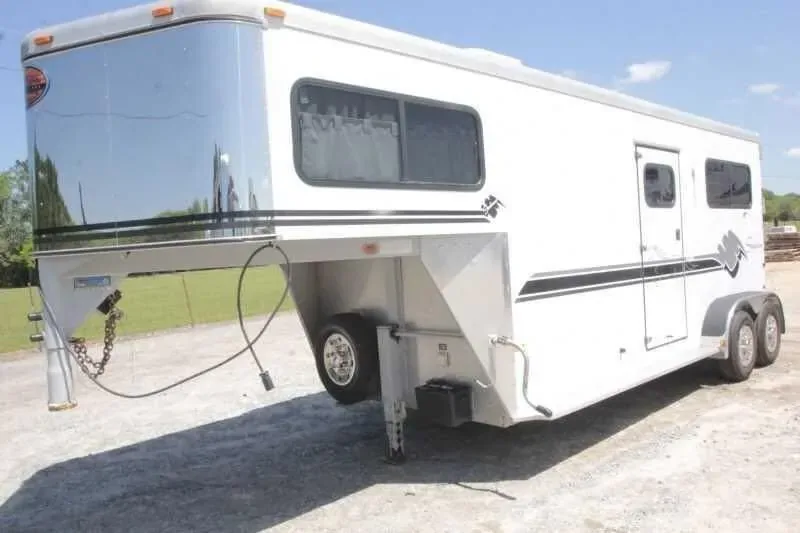
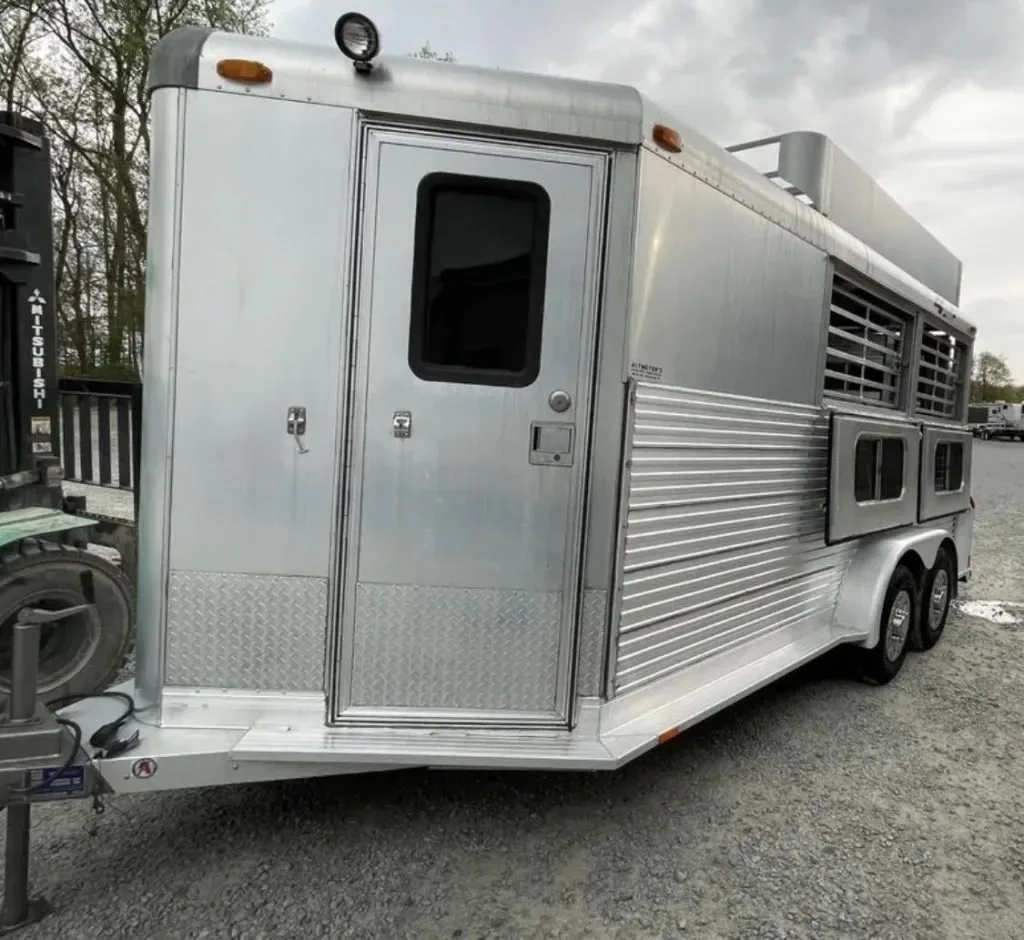
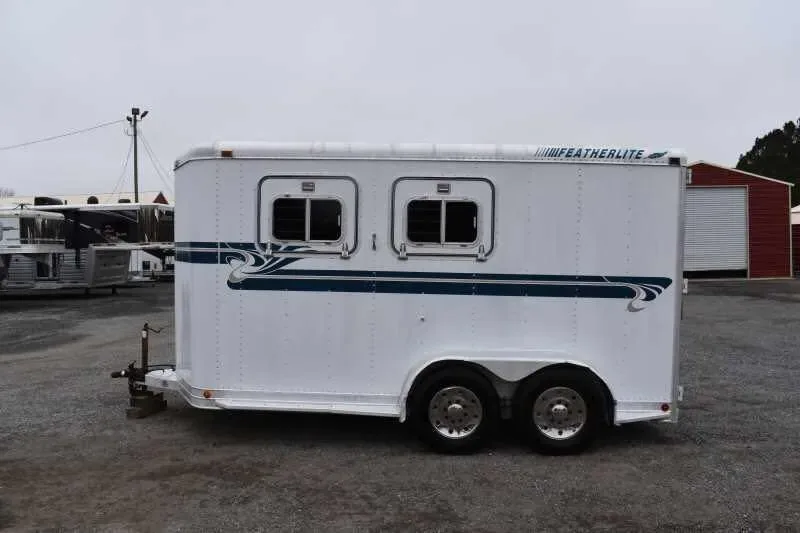
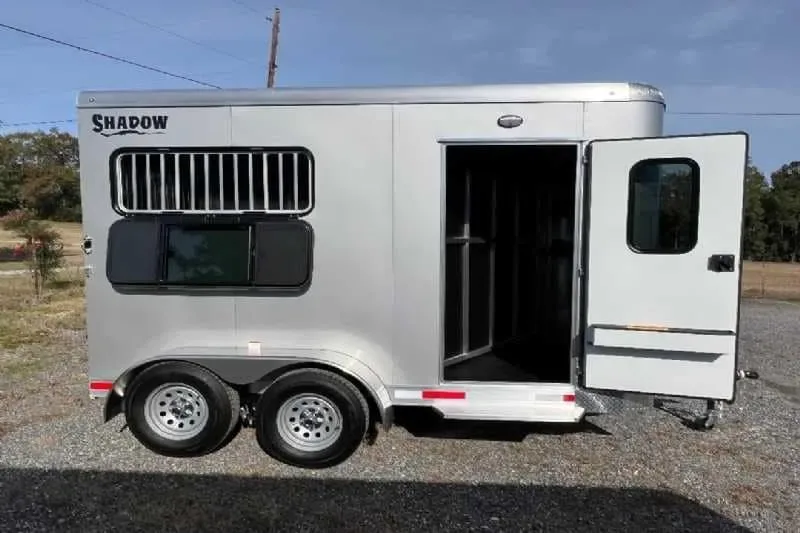
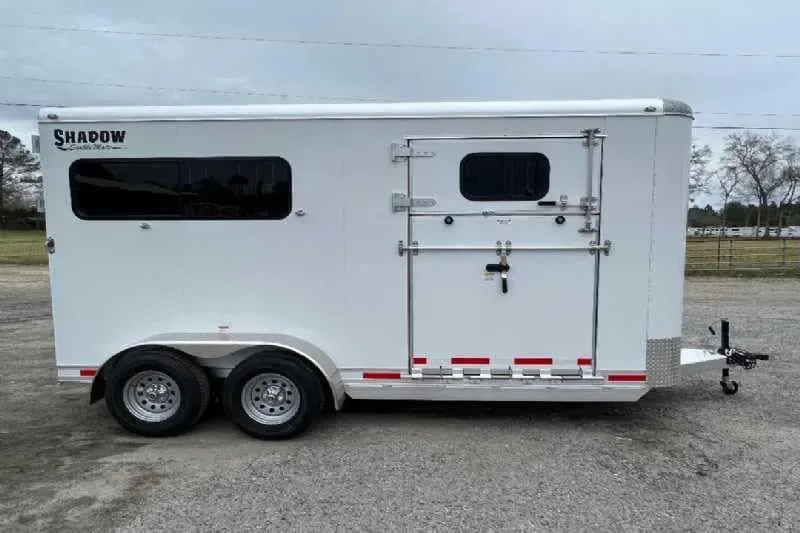
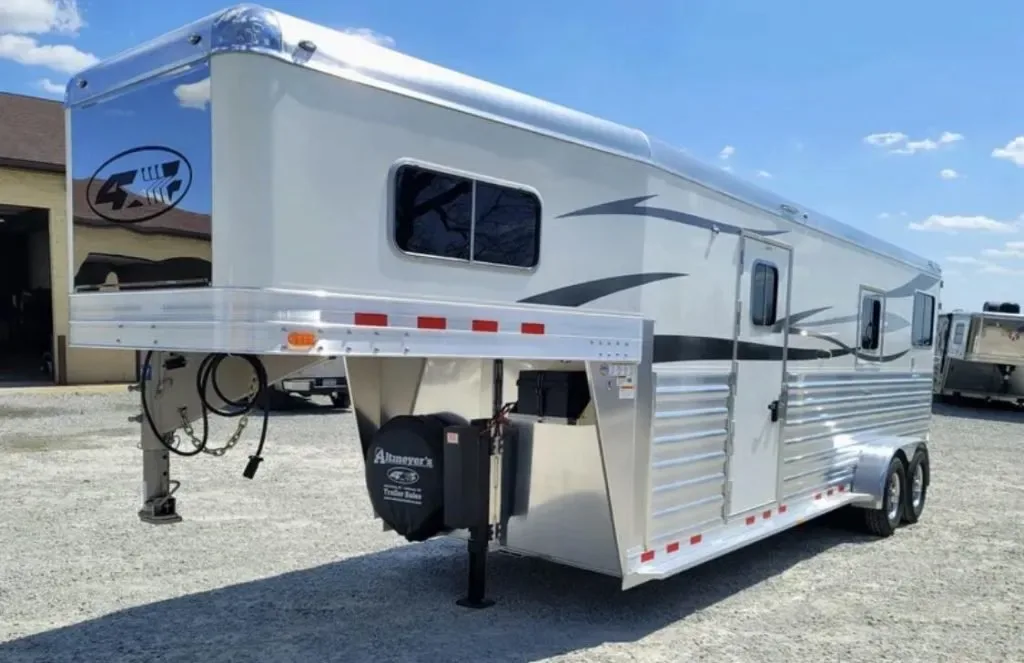
 2023 4 Star 2+1 gooseneck — tap to view
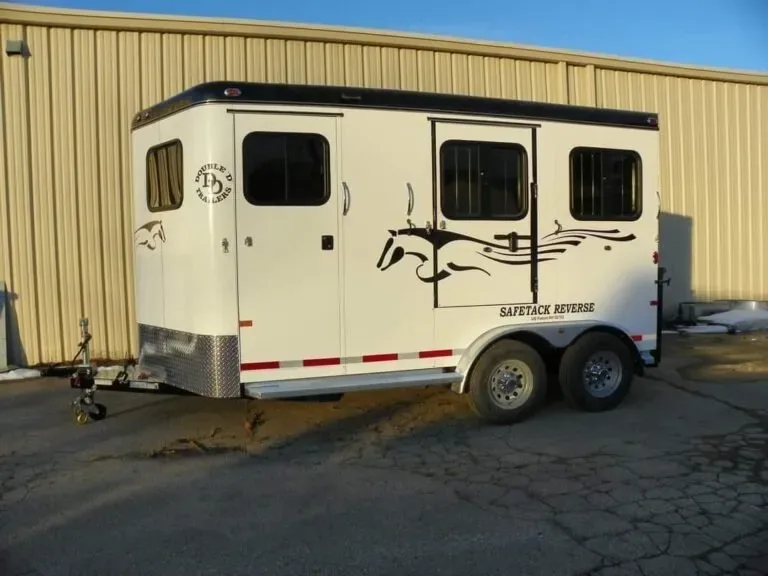 2022 Double D Reverse Slant 2 Horse Bumper Pull — tap to view
Read the listing before you drive out
A used horse trailer listing should tell you five things before you make the trip: year, make, model, GVWR and empty weight. If it doesn't, ask. Every unit on this site lists its year, make, capacity and hitch type, carries real photographs, and is priced in dollars on the page, so you can rule a trailer out from your kitchen table instead of an hour down the road.
Two of those numbers matter more than the rest. GVWR is the most the trailer is allowed to weigh loaded; empty weight is what it weighs now. Subtract one from the other and you have payload for horses, hay, water, tack and people. Two horses at roughly 1,000 to 1,200 lb apiece, plus a full water tank and gear, eats most of the payload on a light 2-horse bumper pull. The certification label on the left front of the tongue or frame gives GVWR and GAWR — read it, and read your truck's door sticker at the same time.
Model year and build year are not always the same thing. The VIN is stamped on the frame and printed on the certification label; they should match each other, and match the title or manufacturer's statement of origin. Titling rules for trailers differ by state, so settle the paperwork before money moves, especially on an out-of-state buy.
Floor and mats
This check ends more deals than any other, and it is the one sellers hope you skip. Mats hide rot.
Lift them. Rear corner first, then anywhere a horse stands, turns or urinates. On a wood floor look for dark staining, soft spots, delamination at the seams, and rot where the floor meets the wall. A screwdriver pressed into the plank tells you more than your boot does. On aluminum, look for pitting and white corrosion under the mat, and check the seams where the planks meet. Then get on your back underneath and look up at the crossmembers: the floor is only as good as what it is fastened to.
Price a floor replacement before you fall in love with the trailer. A failing plank floor is a known cost. A floor that lets go under a horse is a different kind of cost.
Frame, tongue and welds
Surface rust on a steel frame is normal. Scale that flakes off, and rust blooming out of a weld, is not. Look where the load goes: where gooseneck uprights meet the frame, at the spring hangers, at the coupler and jack mount, and along the frame rails where the floor sits.
Then stand at the front and sight down the tongue. A bent or twisted tongue means the trailer took a hit or got overloaded, and that is a walk-away. On an aluminum trailer there is no rust to read, so read the welds instead — hairline cracks at the gussets, and white galvanic corrosion anywhere steel bolts into aluminum.
Coupler, jack and chains
Bumper pull trailers mostly run a 2 in coupler on lighter units and 2 5/16 in on heavier ones. Confirm the size, and confirm it matches the ball on your truck. Then work the latch: it should close, lock, and hold with no slop. A wallowed-out coupler can pop off on a rough road.
Check that both safety chains have solid attachment points and enough length to cross under the tongue, and that the breakaway cable is set up to anchor to the truck rather than the trailer. Run the jack all the way up and all the way down under load. A jack that grinds or will not hold is a cheap fix that tells you how the rest of the trailer was kept.
Axles, bearings and springs
Jack one side up at a time. Spin each wheel and listen — grinding or rumble is a bearing. Grab the tire at 12 and 6 o'clock and rock it; play means bearings or a worn spindle. Look behind the backing plate for grease weeping past the seal, because grease on brake shoes means the brakes are finished.
Read the axle tag for its rating; it should at least match the GAWR on the certification label. Sight along the axle tube from the rear for a bend, and check the leaf springs for a broken leaf, a worn shackle bushing or a collapsed equalizer.
Tires and wheels
Trailer tires age out long before they wear out. Find the DOT date code — four digits, week and year, so 2319 means the 23rd week of 2019 — and treat anything past six or seven years as a replacement regardless of tread depth. Look for sidewall cracking, flat spots from sitting, and cupping that points at a bent axle or a bad bearing.
All four should be the same size and load range, and the load range should suit the trailer's weight. Check the rims for bent lips, and check the spare: a spare older than the tires on the ground is not a spare.
Brakes and breakaway
Most horse trailers run electric drum brakes. If the seller will let you pull one drum, look at shoe thickness and the face of the magnet. If not, plan a test tow and check that the trailer pulls up straight without grabbing or dragging.
The breakaway battery is the most commonly dead part on a used trailer. Open the box on the tongue, read the date on the battery, and pull the switch to see that it moves freely. A breakaway that does not work is a legal problem, not only a safety one.
Lights and wiring
Hook up and check every light: running, brake, both turns, reverse if fitted, interior dome and load lights. Then wiggle the cord and the junction box lid while someone watches. Most trailer lighting faults are ground faults, and they start with water in a lens or a corroded 7-pin plug.
Doors, dividers and bars
Open and close everything twice. Rear door or ramp: the ramp should drop square, sit flush, latch, and be carried by its springs rather than slamming down. A ramp that lets go with a horse on it is how people get hurt.
Escape door at the front — latch, hinge, and whether it opens with one hand. Dividers should swing freely, latch solidly, and still have their pins. Butt bars and chest bars should be present, straight and removable; bars welded in place are a repair, not a feature. On a slant load, check the divider posts where they meet the wall for cracks.
Roof, vents and windows
Get up a ladder, or walk the roof if it will carry you. Look for soft spots, screws backing out of the seams, and sealant that has cracked and pulled away. Open every vent and every drop-down feed window and latch it shut again. Water coming in over a horse's back is a slow way to ruin a trailer.
What to do with what you find
Sort the findings into three piles. Tires, a breakaway battery, a jack and a light are consumables — price them in and carry on. A floor, an axle or a bent tongue is real money, and on a used unit it is usually a walk-away. A crack at a weld is a walk-away, full stop.
If you are still choosing between load types, the horse trailer buyer's guide covers bumper pull against gooseneck, slant against straight load, and aluminum against steel. The FAQ handles the ordering and delivery questions.
Inspecting at the lot in Concord, NC
Units can be inspected at 1122 Matchstick Pl SW, Concord, NC 28025 by appointment, Mon–Fri 8am–6pm and Sat 9am–2pm. Bring your own mechanic, or have a trailer shop look at it — a second set of eyes on the floor and the brakes is the cheapest money you will spend on a used trailer. Bring your truck and your ball if you want to check the hook-up and the tow before you commit.
If you cannot get to the lot, get in touch and ask what we can tell you about a specific unit. Free pick-up at the lot is one option; delivery is quoted to your ZIP and appears in writing on the invoice before anything is paid, so there is no flat rate to guess at. See delivery for how units are moved, then look through the 2-horse trailer listings or the 3-horse units to see what is on the lot today.